
Snowboard Boot and Binding Compatibility: What Actually Works Together
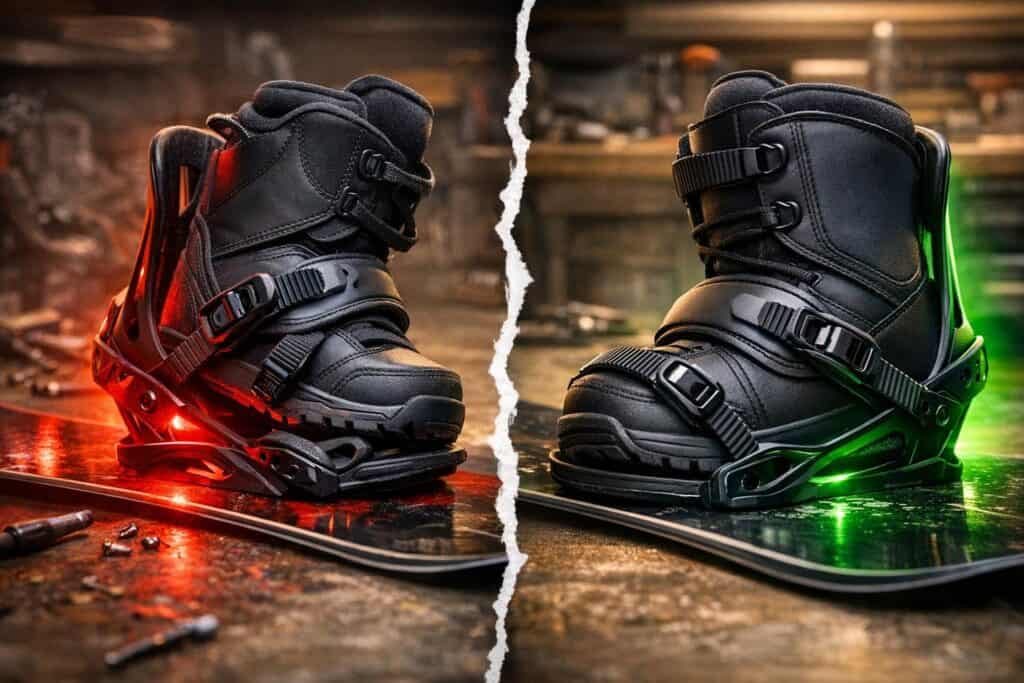
Snowboard boot and binding compatibility comes down to three checks: the binding must mount to your board’s hole pattern, the binding size must match your boot size on that brand’s own chart, and the boot must sit snug in the heel cup with the straps centering over it. Most combinations work. The exceptions — Burton’s Channel boards, Step On and other quick-entry systems, and small women’s boots in men’s bindings — are exactly where beginners get burned, so here’s how each connection actually works before you buy anything.
Connection one: binding to board
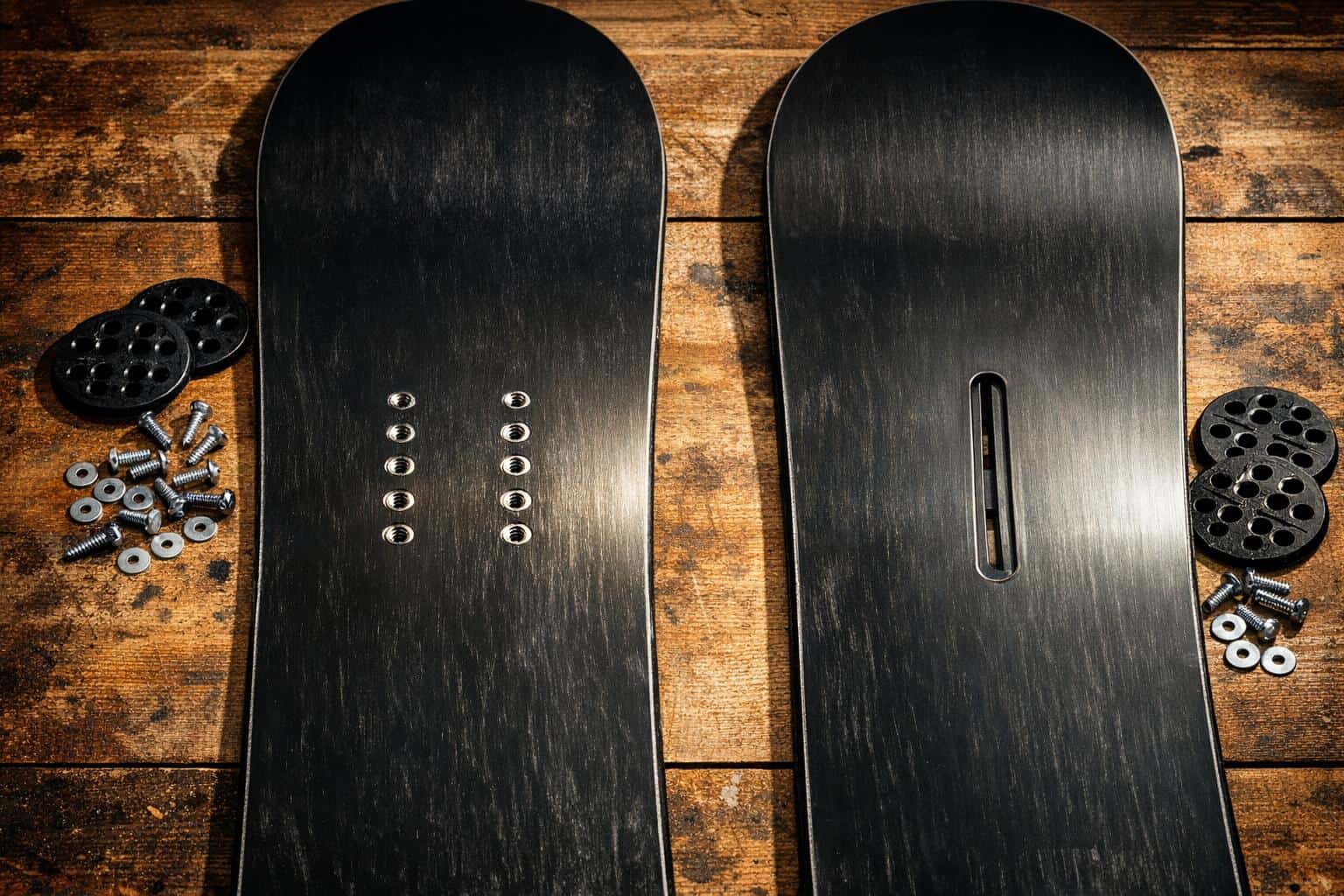
Flip your board over and count the inserts.
- Standard hole patterns (4×4 and 2×4). Rows of threaded inserts. Almost every binding ships with a universal disc that fits both. If your board has these, binding-to-board compatibility is nearly automatic.
- The Burton Channel. One long slot per foot instead of insert rows. Burton’s EST bindings mount only to Channel boards — they don’t work on standard inserts at all. Burton’s Re:Flex bindings work on both the Channel and standard patterns. Most other brands include or sell a Channel-compatible disc, but confirm it for the exact model before you order.
The rule that saves returns: EST is Channel-only; everything else, check the disc.
Connection two: binding size to boot size
Bindings come in sizes (typically S, M, L), and each size covers a range of boot sizes that is different for every brand. A medium in one brand is not a medium in another. Always match your exact boot size against the chart for that specific binding — never assume.
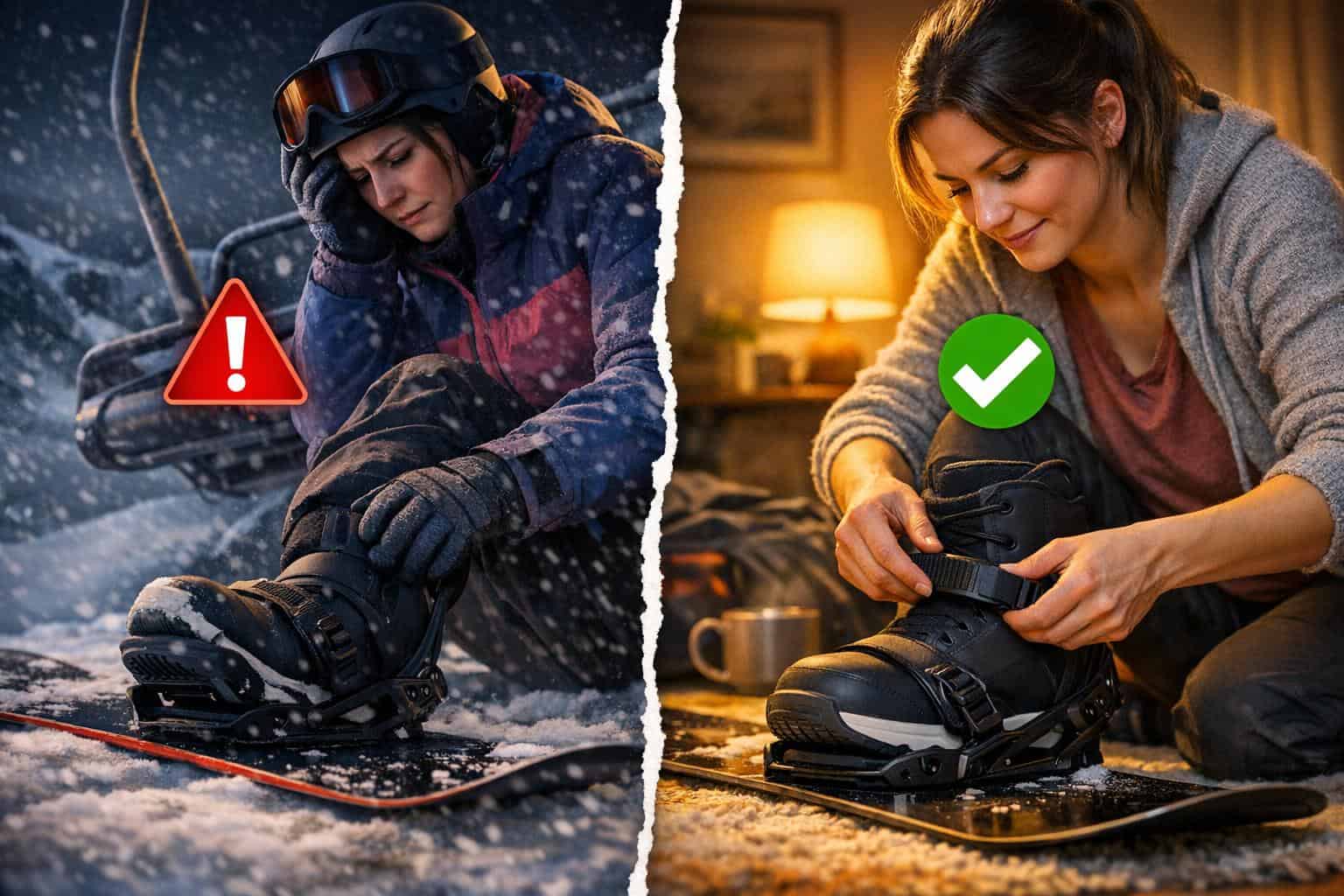
The fit test, done in your living room before you ride:
- Strap the boot in. The heel should sit snug in the heel cup with no side-to-side slop.
- The ankle strap should close over the middle of the boot’s ankle flex zone, not ride high off the top or run out of ladder.
- The toe strap should cap or cradle the toe box squarely.
- Boot overhang past the baseplate should be modest and even. A boot drowning in the binding, or a strap that barely reaches, means the size is wrong even if it technically closes.
Where women get caught: a women’s size 7 boot in a men’s medium binding fails the heel-cup test — the boot swims, the straps crank down at an angle, and heel lift follows no matter how tight you pull. That’s not weak ankles, and it’s not a lacing technique you haven’t learned. It’s a heel cup built around a bigger boot. Women’s bindings exist because the heel cup, strap lengths, and highback height are scaled to smaller boots and lower calves — when the brand did it properly. Check the published size range, not the label.
Connection three: quick-entry systems
Step-in style systems trade some adjustability for convenience, and they’re the one place where the boot and binding are a closed pair:
- Burton Step On requires Step On boots — the cleats on the boot lock into the binding. A regular boot cannot ride a Step On binding, and boot and binding sizes have to match each other per Burton’s chart. If you’re building around Step On, pick the boot first and buy the binding size it calls for.
- Other quick-entry designs each have their own rules: some accept any boot, some don’t. Treat the manufacturer’s compatibility chart as the spec sheet, because that’s what it is.
Limitation worth stating plainly: a quick-entry setup locks you into one brand’s ecosystem for replacements, and selection in smaller women’s sizes can be thinner. Convenience is real; so is the constraint.
Match the flex while you’re at it
Compatibility isn’t only mechanical. A soft, forgiving beginner boot in a stiff aggressive binding (or the reverse) makes the pair fight each other — the stiff half overrides the soft half and the ride feels vague or punishing. Keep boot and binding in the same flex neighborhood: soft with soft for learning, stiffer together as you progress.
The pre-purchase checklist
| Check | Pass looks like |
|---|---|
| Board hole pattern vs binding disc | 4×4/2×4 with universal disc, or Channel with EST/Re:Flex/compatible disc |
| Boot size vs binding chart | Your exact boot size inside that binding’s published range |
| Heel cup | Boot heel seats snug, no side slop |
| Straps | Center over the boot with ladder to spare |
| System boots | Step On boot for Step On binding, sizes matched |
| Flex | Boot and binding in the same flex range |
Next step: price the pieces
Once the checks above pass on paper, compare current listings for the parts you still need. Match the size range on the listing against your boot size before anything goes in a cart.
Check Current Price: women’s snowboard boots
Check Current Price: women’s snowboard bindings
Check Current Price: Burton Step On bindings
Common questions
Do bindings fit any snowboard?
Mostly. Standard 4×4 and 2×4 insert patterns take nearly any binding with a universal disc. The exception is Burton’s Channel system — EST bindings only fit the Channel, and other bindings need a compatible disc.
Can I use men’s bindings with women’s boots?
If your boot size falls inside that binding’s published range and passes the heel-cup and strap tests, yes. Small women’s boot sizes usually fall below men’s ranges, which is why the pairing so often fails. Run the test, don’t trust the label.
Do boots need to be the same brand as bindings?
No — except for closed systems like Step On. Any standard strap binding takes any standard boot that passes the size and fit checks.
Do Burton Step On bindings work with any boot?
No. Step On bindings only lock onto Step On-compatible boots, which carry the cleats the binding grabs. Burton makes most of them, and a few other brands, including DC and Nitro, make compatible models. A regular strap-binding boot will not work.
Do Burton Step On bindings work with any board?
It depends on the version. Step On Re:Flex bindings mount to the Channel and to standard insert patterns with the right disc. Step On EST bindings fit Channel boards only. Check which version a listing is before you buy.
Get the rest of the setup right
- Boots come first — run the women’s snowboard boot fit checks before you size a binding around them
- Size the board itself with the women’s snowboard size calculator
- See complete beginner setups in the beginner women’s snowboard roundup and the beginner gear guide
Sources
- evo: How to Choose Snowboard Bindings & Compatibility Guide
- Burton: Step On and EST manuals (system compatibility requirements)
- Burton: Step On bindings overview (compatible boots, Re:Flex and EST)
The Gear Lady evaluates gear using the Ergonomic Matrix — a published framework applied to manufacturer specs, standards ratings, and aggregated owner reports from women who share their measurements. We don’t field-test every product we cover. We earn commission on some links — as an Amazon Associate, The Gear Lady earns from qualifying purchases — and it never affects a score.
